LEADERSHIP & TECHNOLOGY
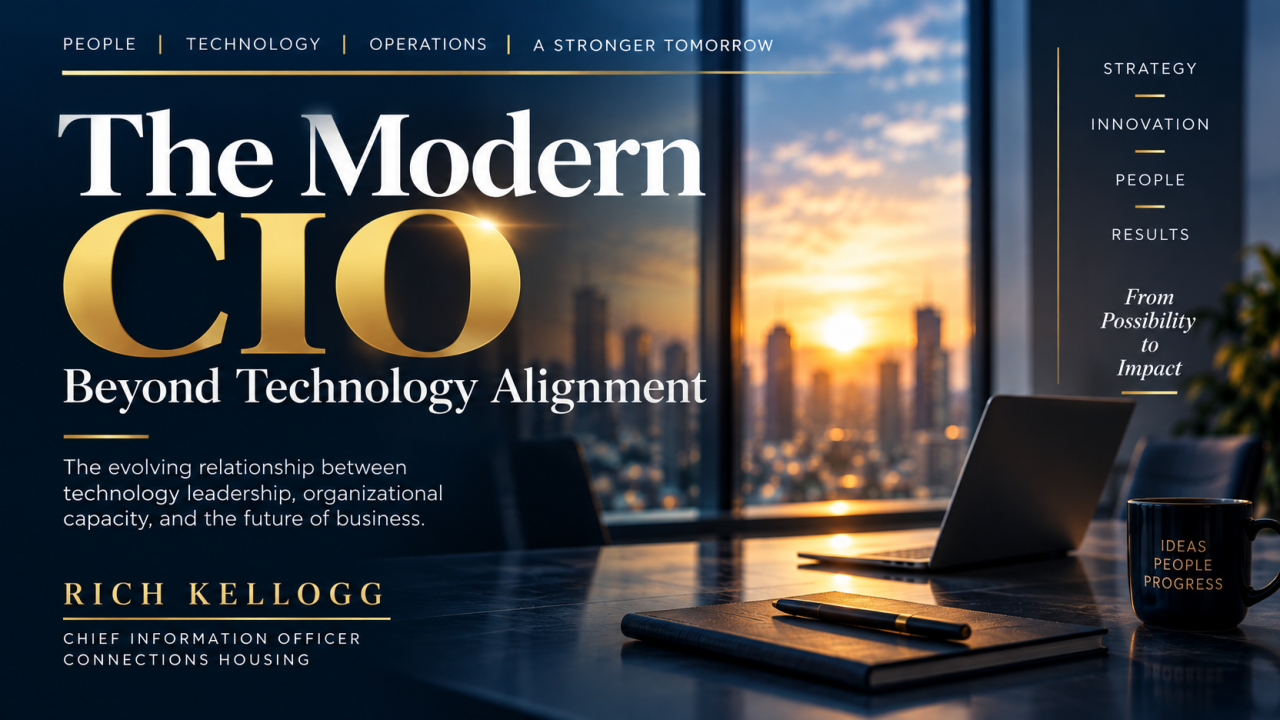
The Modern CIO:
Beyond Technology Alignment
The evolving relationship between technology leadership, organizational capacity, and the future of business.
Over more than three decades working in technology, I've witnessed extraordinary changes in how businesses communicate, operate, and compete. From the early days of business telecommunications and network infrastructure to enterprise software and today's rapidly advancing artificial intelligence, each generation of technology has brought new capabilities and new challenges. Yet the transformation taking place today is different in an important respect. Technology is advancing at a pace that increasingly challenges the ability of traditional business structures and operational methodologies to keep pace. This is fundamentally changing what organizations should expect from their Chief Information Officer.
Historically, much of the CIO's responsibility centered on the internal technology environment. Infrastructure, systems, connectivity, security, and technical operations were the foundation of the role. Those responsibilities remain essential and, in many respects, have grown considerably more complex. However, the modern CIO must increasingly extend beyond managing the technology organization to understanding how emerging capabilities will influence the direction of the business itself. That requires a broader perspective, one that connects technological advancement with executive strategy, operational processes, organizational structure, and long-term financial performance.
For years, technology alignment has been a central objective of successful IT leadership. Understand the company's vision, identify the technological requirements, and develop the systems necessary to support its operations and strategic goals. While that principle remains relevant, alignment alone is becoming insufficient. The accelerating pace of technological advancement, particularly in artificial intelligence and automation, introduces another critical consideration: whether the organization has the capacity to evolve at a pace that allows it to benefit from those advancements. A company may have the financial resources and technical expertise to implement sophisticated systems, yet remain constrained by business processes, operational methodologies, and organizational structures that were developed for an entirely different technological environment.
This creates a challenge that extends well beyond technology adoption. Organizations must consider not simply whether their technology strategy aligns with their business objectives, but whether their operating models and internal capabilities are evolving quickly enough to realize the value of those investments. Technology can create extraordinary opportunities for efficiency, automation, and improved service delivery, but those opportunities do not automatically translate into business results. The people, processes, responsibilities, and methodologies surrounding the technology must also evolve. Without that progression, organizations risk building increasingly sophisticated technological environments around operational structures that cannot fully utilize them.
The financial implications of this disconnect are particularly significant. As companies invest in artificial intelligence, software development, automation, and increasingly advanced enterprise platforms, they incur the costs of developing and maintaining these capabilities. However, when the underlying business model fails to evolve, many of the operational expenses that those investments were intended to improve remain in place. The organization effectively faces two substantial cost structures: the investment required to advance its technology and the ongoing expense of operating through traditional business methodologies. Meanwhile, competitors that successfully integrate technological efficiencies into their operations may be able to deliver comparable or enhanced services at lower cost, creating additional pressure on pricing and profitability. Over time, this combination has the potential to place businesses in a difficult competitive and financial position.
Addressing this challenge requires more than implementing new systems or reducing operational expenses. It requires an intentional approach to organizational development to ensure that the right people, capabilities, and business processes are in place to take advantage of emerging technologies. In many cases, this means reconsidering how work is performed, where human expertise creates the greatest value, and how technology can assume responsibilities that previously required substantial manual effort. The objective is not simply to automate existing processes, but to develop an operating model in which technology and organizational resources complement one another, improving efficiency while preserving the expertise, relationships, and service quality that distinguish a business.
This evolution also changes the leadership expectations placed on the CIO. A capable Director of IT and a well-established technology organization remain critical to managing the internal environment, maintaining operational reliability, and executing technological initiatives. With that foundation in place, the CIO must be increasingly outward-facing, working alongside the CEO, COO, CFO, and other executive leaders to understand where the business is heading and how its operating model must evolve. It requires looking beyond the technology department to understand customer expectations, market conditions, operational constraints, and emerging opportunities. The CIO's responsibility becomes one of helping connect what technology makes possible with what the organization must be prepared to accomplish.
At Connections Housing, this perspective influences how I approach technology leadership and the continuing evolution of our proprietary enterprise software platform, Event Wizard. The objective extends beyond developing applications that support existing business functions. It involves creating an integrated technology environment that connects operational processes, management intelligence, and client-facing capabilities while providing a foundation for continued innovation. Equally important is the collaboration between technology and operational leadership, ensuring that the solutions developed reflect both today's business realities and the capabilities needed to address tomorrow's complexities.
None of this suggests that organizations should pursue every emerging technology or attempt to adopt every advancement as it appears. Effective leadership requires evaluating which developments create meaningful business opportunities and determining how the organization can implement them responsibly and efficiently. The greater challenge is establishing the organizational flexibility, leadership capacity, and operational readiness necessary to respond when those opportunities arise. As the technology curve continues to accelerate, the ability to make those adjustments may become an increasingly important distinction between organizations that merely invest in innovation and those that translate innovation into sustainable business value.
The modern CIO must therefore be more than the executive responsible for advancing an organization's technology. The position increasingly requires a strategic partnership with business leadership to ensure that technological capabilities and organizational capacity evolve together. The question is no longer simply whether technology can support the company's future direction, but whether the company is developing the people, processes, and operating model necessary to move forward with it.
Technology alignment remains essential. The organization's ability to evolve alongside that technology will ultimately determine its value.